After leaving the Bretton Woods system in 1971, every country in the world has moved to a fiat currency. Under a fiat system, there is a universal economic Trilemma which all central banks must abide by.The US and majority of first-world countries operate a floating exchange system (Open Economy without exchange rate stability).
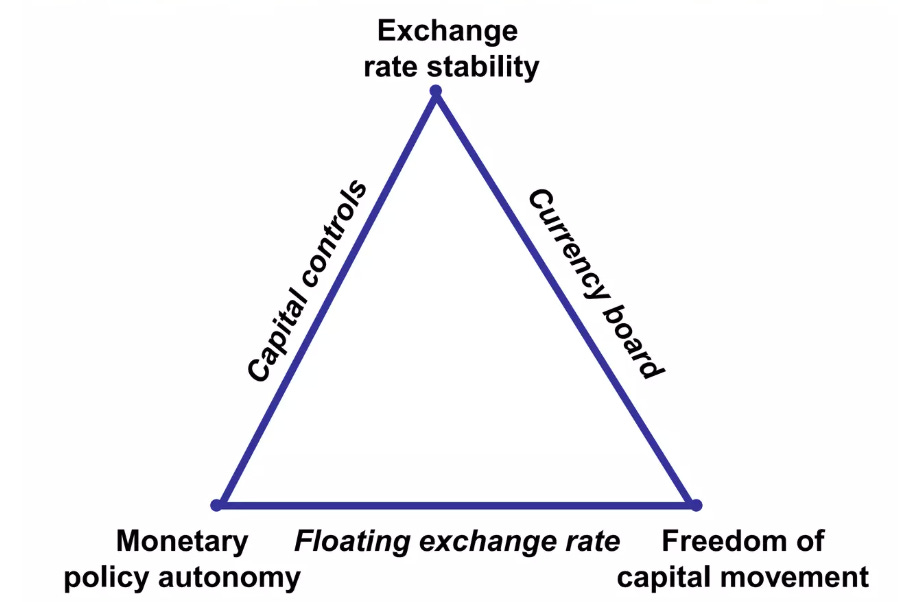
Central Banks All Face the Monetary Trilemma:
Fixed Exchange Rate (Lack of Stability)
Pegged exchange rate to a currency (Yuan to USD)
Pegged to fixed assets (ie. Gold and Silver)
Interest Rate Controls (Lack of Monetary Policy Autonomy)
Ability to manipulate Interest Rates (Eurozone)
Ability to expand and contract credit (Greece)
Capital Controls (Lack of Freedom of Capital Movement)
Ability to take Currency out of the country (India)
Ability to spend Currency as desired (banishment of Gold Purchases & Ownership in US 1933-1971)
The graph and list above are the monetary trilemmas. An economy can achieve 2 of the three.
Countries that want to manipulate interest rates and maintain stable currency will limit their capital controls. China pegs the Yuan to the USD and has interest rate autonomy, capital cannot leave the country.
Countries that want to have a stable currency and free capital control will lack monetary policy autonomy. EU countries have a stable currency and capital movement; they cannot individually manipulate interest rates.
In the United States, we have the ability to control interest rates and significant freedom of capital movement, besides regulatory reporting when traveling with more than $10k, and the ability to invest overseas in most countries and assets. Although we are perceived to have exchange rate stability as measured in by the DXY index, as shown in the straight line M2 Log Chart from the first writing, our currency is exponentially losing value.
In the likely near term, this exponential devaluation will require action.
Knowing the fiscal status and necessity of interest rate controls, the United States will be forced to implement capital controls. These will begin under the guise of national security and expand as necessary. For reference, the US has implemented capital predominately during wartime, Revolutionary War, War of 1812, Civil War, WWI, WWII, Vietnam War, and is even seen today with the recent COINS Act. This is a trap.
Before the gates close, capital will continue fleeing to hard assets, gold, silver, productive land, etc. These assets have the ability to outlast depreciation, and some can be held out of the grasp of a greedy, desperate government.
It behooves all individuals to jump on the hard assets train to any degree. The current national portfolio allocation to hard assets is below 1%, whereas historical standards have been greater than 25%.