
Demographic trends predict your great-grandchildren’s future.
“As the twenty-first century began, human evolution was at a turning point. Natural selection, the process by which the strongest, the smartest, the fastest, reproduced in greater numbers than the rest, a process which had once favored the noblest traits of man, now began to favor different traits. Most science fiction of the day predicted a future that was more civilized and more intelligent. But, as time went on, things seemed to be heading in the opposite direction. A dumbing down. How did this happen? Evolution does not necessarily reward intelligence. With no natural predators to thin the herd, it began to simply reward those who reproduced the most, and left the intelligent to become an endangered species.” - Idiocracy
It is difficult for most people to conceptualize something 1,000 years away, 100-years away, hell even a month away. This inability to see long-term trends and calculate responses will have detrimental impacts on humanity.
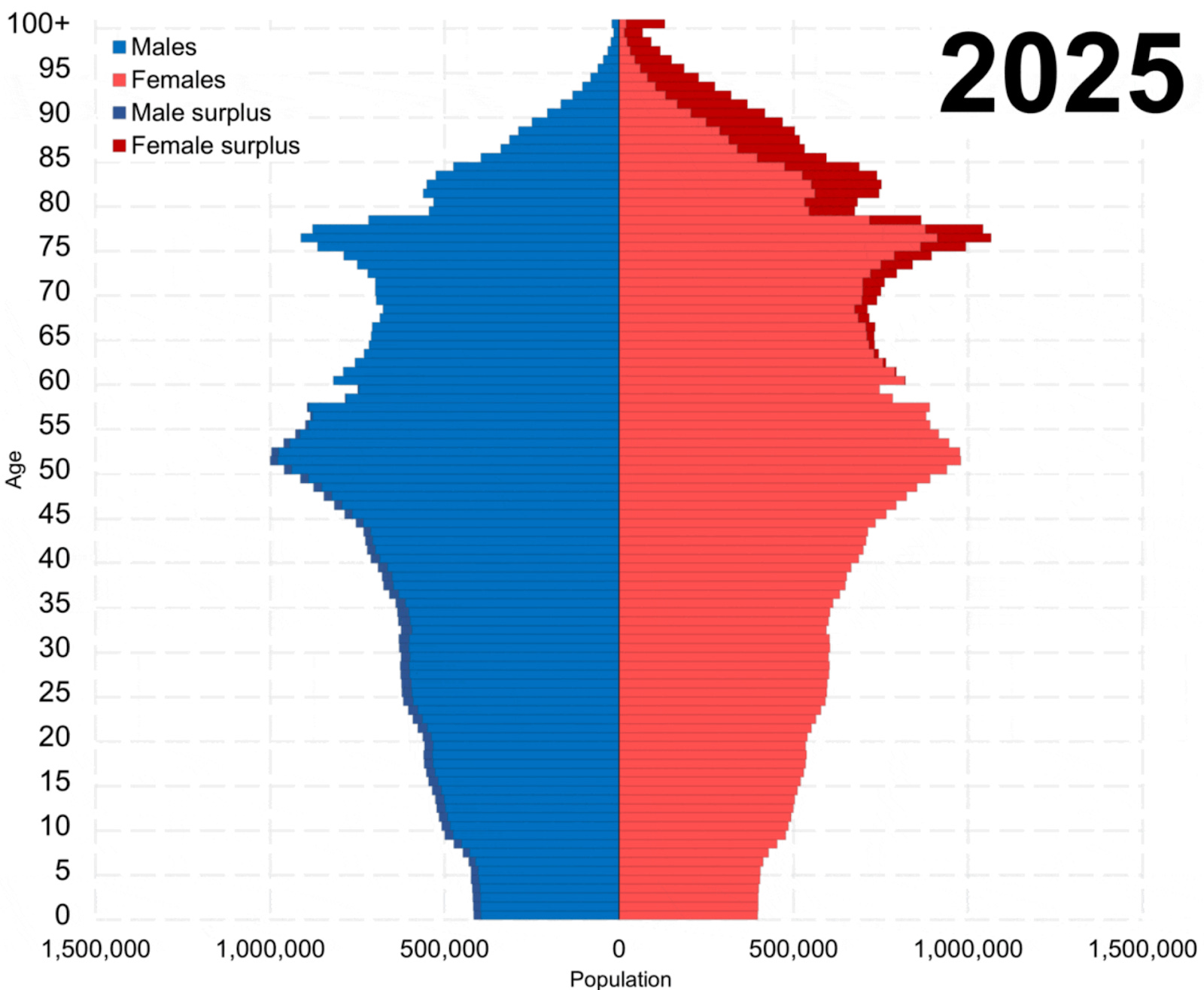
Japan is a leading indicator for what happens when birth rates go below 2.1/family. Every generational cycle, Japan will lose nearly half of the preceding population. Without a growing population, there are limited social benefits for seniors, and 25% of those older than 65 participate in the labor market vs 19% in the US. These numbers will rise for both countries over the next few decades. The lack of growth in Japan stems from their restrictive immigration policies vis-a-vis Europe and the US. This will lead to the destruction of their country economically; socially, they will remain strong as they have since the Meji Restoration from feudal states in the early 1600’s.
Europe and the US have chosen to remain economically viable contenders on the global chessboard.
Immigration has stepped in to reduce the burden of a lower fertility rate (1.45 in Europe and 1.6 in the US). Although helping countries economically, immigration is degrading the historic cultures of former empires.
Illinois K-12 reading and math proficiency ratings increased from 41% and 28%, respectively, in 2024 to 53% and 39% in 2025. The standards were lowered. 2026 data from Polizei Berlin state 55% of new cadets require remedial German language training. This is leading to cultural and societal degradation.
Immigration is not inherently bad. Who immigrates is what matters. We are a country founded on immigrants; historically, one had to be resourceful to survive in America. With handouts creating a baseline survival rate, the best and brightest are not forged in the new land. Immigrants can come to America and have a higher standard of living than in their native countries at baseline poverty levels.
Cultural preservation is not racist. It is an expected standard of living in a high-trust society. We can either reproduce internally or immigrate to sustain growth. With the latter, we must demand a cultural standard of integrity, trust, and growth, lest we fear being succumbed to degradation.
“Unaware of what year it was, Joe wandered the streets desperate for help. But the English language had deteriorated into a hybrid of hillbilly, valleygirl, inner-city slang, and various grunts. Joe was able to understand them, but when he spoke in an ordinary voice, he sounded pompous and faggy to them.” - Idiocracy