
After witnessing the tumultuous, volatile periods of the last few years, I want to personally extend my thoughts and commentary on the economic state of affairs and where I believe we are headed. My goal is to provide clarity and assurance by filtering media noise and utilizing critical thinking to project over medium and long term time horizons.
Pedagogy is the fundamental root of growth; works of the past provide the building blocks and tutorials for our future. These discourses will draw on the works of Austrian Economists and share their conclusions for how the world truly operates, understanding all means revert. The quote below was given in 1951, seven years after the establishment of the Bretton Woods agreement where US Dollar hegemony was established.
“Inflation, as this term was always used everywhere and especially in this country, means increasing the quantity of money and bank notes in circulation and the quantity of bank deposits subject to check. But people today use the term ‘inflation’ to refer to the phenomenon that is an inevitable consequence of inflation, that is the tendency of all prices and wage rates to rise. The result of this deplorable confusion is that there is no term left to signify the cause of this rise in prices and wages. There is no longer any word available to signify the phenomenon that has been, up to now, called inflation.” - Ludwig von Mises
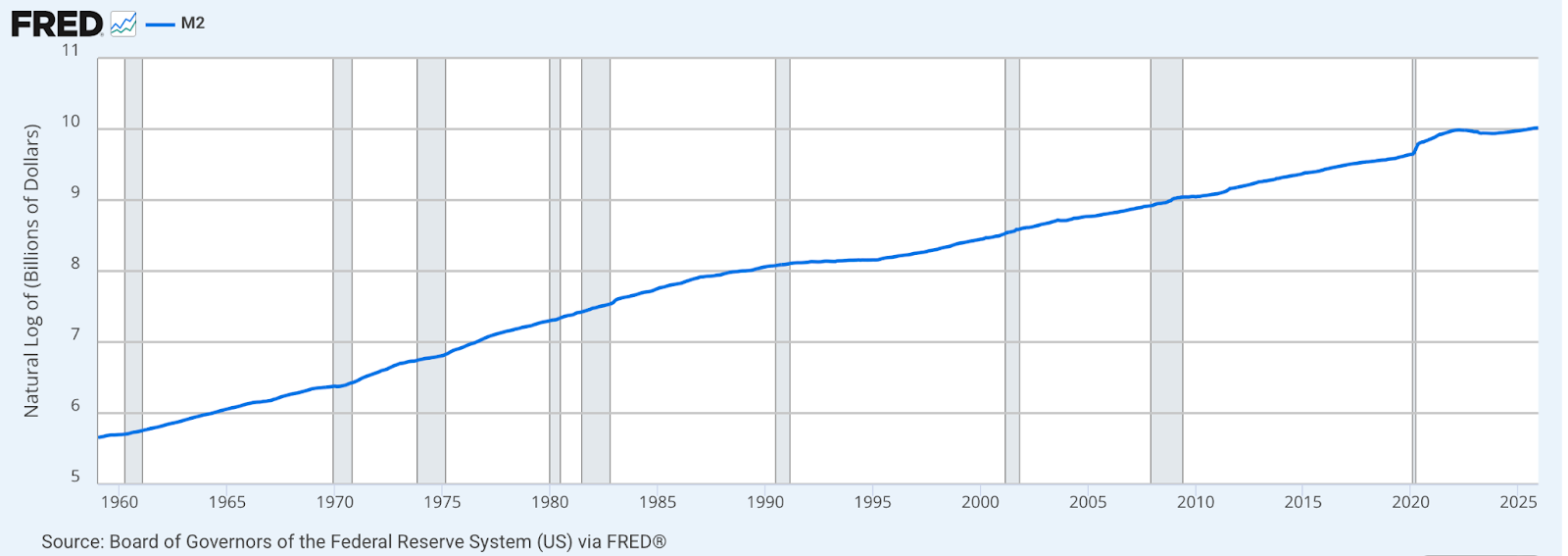
The chart above is the expansion of the United States Money Supply starting in 1959. Albeit “tied” to gold at the time, one can see the linear rise in supply which, led by the French repatriating their gold, forced Nixon to close gold convertibility and took the United States off the gold standard. This line continues in a near perfect linear fashion, with a slight blip during Covid, to today. The Y-Axis is logarithmic, normalizing the compounding nature of this chart. Observing the trendline, we can extrapolate this over the next decade revealing a true hockey stick in nominal figures. With an average 7%, we can assume the money supply will continue doubling every 10 years. As von Mises states, that is the fundamental definition of inflation, and that new money will always need to find a home.
New money is channeled through the economy in the Cantillion Effect. As money is printed, it benefits those receiving funds directly from the printing press (US Treasury and Federal Reserve) by allowing purchases at lower costs - when less currency was in the system. The immediate benefactors are those receiving direct payments (ie. Alphabet Agencies, Govt. Contractors, and Commercial Banks). This advantage comes at the expense of you and me, the everyday taxpayer. Next, we will delve into the history and requirements of money, explaining how we have been indoctrinated into believing currency is absolute money.