
After an 8-month hiatus from bombing the Middle East, the US is back in action. Operation Epic Fury is in full force as missiles volley back and forth between Tehran and Tel Aviv faster than balls on Wimbledon’s grass.
On the global hierarchy, there are a few reasons why the United States is sending troops back to the Middle East. It could be zionist puppetry, or ending a CIA-backed regime, tumbling another domino in the deepstate house of cards. Those are theories. What’s below are facts.
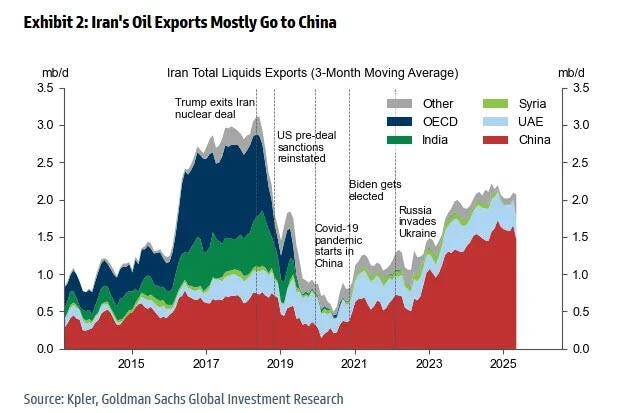
Although sanctioned, Iran has been selling oil to China, helping finance Iran and support China’s economy and war machine. The quantities alone aren’t the factor. When combined with Venezuela, the US is strategically removing key importers from China’s 70% imported oil market. Through their Belt and Road initiative (and in exchange for oil), China is heavily invested in Iranian infrastructure.
Technologically, their telecom infrastructure was constructed by Huawei. As well, they have installed facial recognition cameras, helping leadership and police create a surveillance state. Physically, China built the Qom-Yiwu Rail Link connecting key trading hubs and has been sending contractors to create major highway systems through Iran. So if the problem is with China, why are we bombing Iran?
Iran, directly and through terror organizations like the Houthis, has for years attacked cargo ships traversing the Strait of Hormuz. 30% of the world’s seaborne oil trades through this narrow strait of Iran’s coast. Military security, predominantly US, has been required for any non-Iranian or Chinese ship traversing these waters. Through 2025, the US Navy has spent over $3B defending the strait and have used over 25% of their interceptor missile stockpile.
The US must defend global oil trades, an informal mandate to keep the petrodollar intact, however, endless naval guerrilla warfare will deplete stockpiles and leave the US vulnerable in the event of a Pacific theater. To combat this, they are moving first to stop the repeated drain of munitions and to attack China’s resources.
In the Pacific, there is relatively limited oil production. The largest of which are China and Indonesia. In WWII, the Japanese required oil for their new age, agile ships and airplanes. Without native reserves, they were forced to fight their way south in an attempt to secure the Indonesian fields, which required them to spread wide before moving east. The Allies utilized a scorched earth policy in their retreat, destroying all infrastructure so the Japanese could not take over, a similar strategy used in Romania and Maikop against the Nazis.
If we see a stronger US military influence in SE Asia next, it will be clear that we are prepared for conflict. Historically, military events have been the primary catalyst for Monetary Resets; a common enemy would be a great distraction and excuse for the continuing, breakaway inflation.